

Profile Sheet brochure downloads


Flat Sheet & Twinwall Installation downloads


Accessories brochure downloads


Industrial brochure downloads


Installation
Getting the installation right protects both the performance and the warranty of your plastic roofing. Below you'll find our general installation guidance for polycarbonate, acrylic, and twinwall sheeting, along with full downloadable installation guides for each product. If you're not confident installing it yourself, our team can point you toward a trusted installer.
General installation principles
Whether you're installing profiled polycarbonate, flat acrylic, or twinwall sheeting, a few principles apply across the board. Always allow for expansion, typically 3mm per side at the joiner and 3mm per lineal metre at the top of the sheet, since polycarbonate and acrylic expand and contract with temperature. Pre-drill fixing holes rather than fixing straight through, and space fixings at 400mm centres under normal conditions, tightened to 300mm in high wind zones. Fit flashings or back channel at the high end of the roof before fitting the sheet itself, and finish by hosing the sheet down from the top to clear dust and debris from the install.
Handling, storage and cleaning
How you handle and maintain plastic roofing sheet directly affects your warranty. Store sheets flat, in a shaded, well-ventilated area, out of direct sunlight, since stacked sheets left in the sun can distort from heat build-up. Keep moisture from getting between stored sheets, as this can cause whitening or discolouration. Avoid contact with chemicals, paints, solvents, and sealants, particularly silicone, since many of these react with polycarbonate. Clean panels at least twice a year, ideally in spring and autumn, using warm water and a soft sponge or brush. Manufacturer warranties do not apply to damage caused by failing to follow these handling and care instructions.
What you'll need before you start
The tools and materials required depend on which product you're installing.
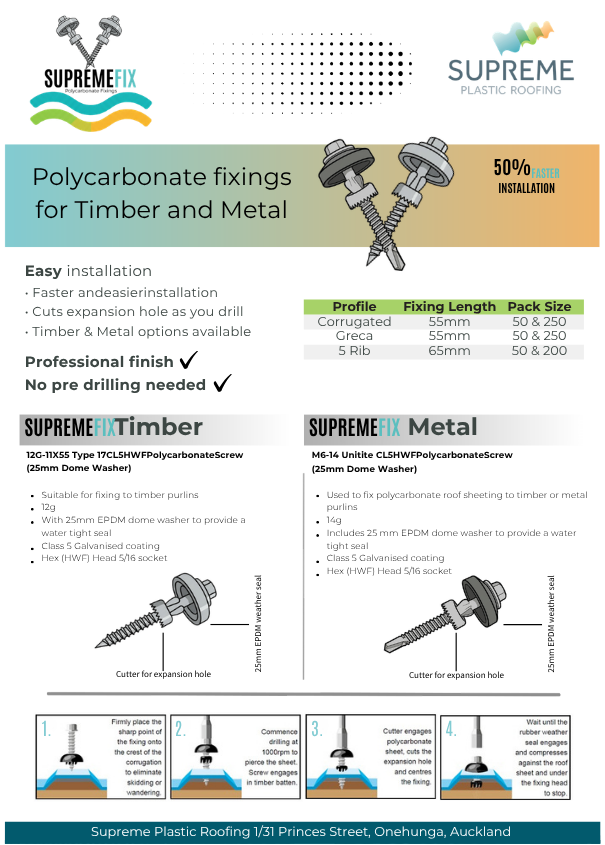
For profiled polycarbonate (corrugated, Greca, 5-Rib): tin snips or a circular saw with a fine-toothed blade, a drill, Laserlite Polycarbonate Fixings or AONE Multipurpose Fasteners, safety glasses, and walking boards for the roof.
For twinwall and flat acrylic sheet: a straight edge and Stanley knife (twinwall) or fine-toothed saw blade (acrylic), an aluminium glazing bar joiner, anti-noise tape, anti-dust tape and end caps (twinwall only), stainless steel screws with bonded washers, and a tape measure for confirming rafter spacing before cutting.
For Topglass fibreglass: an abrasive disc or fine-toothed saw, protective gloves, an approved face mask, and safety mesh for underneath the sheet.
Across all products, keep sheeting stored flat and undercover until you're ready to install, and check your local wind zone before deciding on fixing spacing.
Frequently Asked Questions
Profiled polycarbonate is fixed directly onto rafters or purlins at a minimum 5° pitch, with fixings every second rib for corrugated and Greca, and every rib for 5-Rib. Twinwall and flat acrylic sheet are installed differently, using an aluminium glazing bar joiner rather than being fixed straight through the sheet.
Twinwall installs into an aluminium joiner fixed to the rafter, with anti-noise tape applied to any purlins first. The sheet is cut allowing for expansion, dust tape is applied to the open flute ends, and the sheet slides into the joiner before the top cover locks into place. A full step-by-step guide is available as a downloadable PDF.
Acrylic sheet installs the same way as twinwall, using an aluminium joiner fixed to the rafter first. Sheets are cut with a fine-toothed saw blade, allowing 3mm expansion per side and 3mm per lineal metre at the top.
Allow 3mm expansion per side at the joiner and 3mm per lineal metre at the high end of the sheet. This applies to both twinwall and flat acrylic sheet, since both expand and contract with temperature changes.
No specialist tools are required. Profiled polycarbonate can be cut with tin snips or a fine-toothed circular saw. Twinwall is best cut with a straight edge and Stanley knife rather than a saw, since a saw blows swarf into the internal flutes. Acrylic sheet is cut with a fine-toothed saw or jigsaw blade.
Store sheets flat, in a shaded and well-ventilated area, out of direct sunlight. Stacked sheets left in the sun can distort from heat build-up, even when covered. Keep moisture from getting between stored sheets, as this can cause whitening or discolouration.
Generally, no. The installation method is designed to prevent leaking without needing sealant. Avoid silicone and most other sealants, as they can damage the sheet and restrict its ability to expand and contract. If a sealant is genuinely required, only use a neutral sealant made specifically for polycarbonate roofing.
Clean panels at least twice a year, ideally in spring and autumn, with warm soapy water and a soft sponge or brush. Manufacturer warranties do not cover damage caused by failing to follow the recommended handling, storage, and cleaning instructions.
Fixing spacing depends on the product. Profiled sheet is fixed every second rib for corrugated and Greca, and every rib for 5-Rib. Twinwall and acrylic sheet installed via aluminium joiner use stainless steel screws with bonded washers through the joiner, typically every metre, tightened to every 500mm in high wind areas.
Most of our products are designed for confident DIY installation, and each comes with a full downloadable installation guide. If you'd rather not install it yourself, our team can help point you toward a trusted installer.